What is the most important contribution of this paper?
The most important contribution of this paper is introducing a conceptual framework and a set of seven guidelines to conduct, evaluate and present design science research in the IS (Information Systems) discipline.
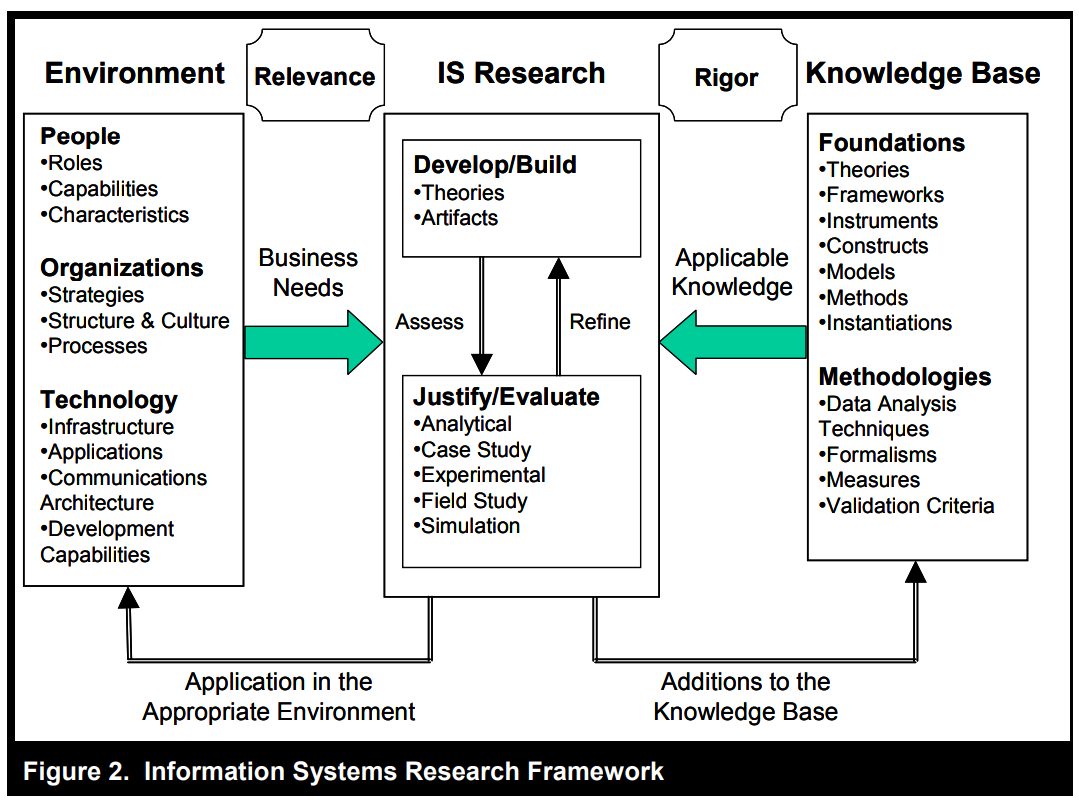
The conceptual framework includes 3 main pillars:
- The Environment (relevance of the research), source of the “wicked problems”
- The Knowledge base (foundations and rigor of the research), research takes from/contributes to it
- IS Research - building and evaluating artefacts to solve business problems
Seven presented guidelines serve as the checklist for a high-quality design research. They ensure that it is not just “routine design”, but a rigorous research that contributes back to the knowledge in the field. The guidelines also state, that the result of the research has to be a purposeful artefact that must have utility for a relevant business problem and be rigorously evaluated.
The paper also highlights the interconnection of design science and behavioral science to enable full IS research and development (a technological innovation with reactive behavioral study).
- this paper is mainly about how to develop and invent better Information Systems using two main components:
- design-science as the proactive part
- this approach uses scientific ways to research and develop/invent new artefacts (be it a construct, model, method or instantiation (see below))
- focused on the utility of new tools, creations, methodologies to solve problems
- it uses kernel theories/knowledge (from behavioral science, natural science)
- those are applied and tested though the constructing of the artefact
- extended knowledge base is built by constructing and evaluating artefacts
- it uses kernel theories/knowledge (from behavioral science, natural science)
- behavioral science as the reactive part
- studies human and organization behavior and comes with important findings about how humans behave, communicate and how they interact with the world (here with the Information Systems)
- it seeks the “truth”, it observes, it does not create anything new
- it develops and verifies theories that explain or predict human behavior (regarding the management of the Information System)
- design-science as the proactive part
- why do we need a better Information System?
- to manage people and organizations better, to save and/or utilize resources, to speed up/eliminate processes, to control etc.
- it is driven by real business requirements
- managers have a business strategy and they are designing the organizational infrastructure
- and it has to be aligned with the information systems infrastructure
- managers have a business strategy and they are designing the organizational infrastructure
The IS Research framework
- three pillars
- The Environment - provides the business needs (people, organizations, technology)
- this ensures relevance (you don’t want to develop anything that is not relevant)
- The Knowledge base - provides foundations (theories, previous artefacts, experience etc.) and methodologies (data analysis, validation etc.)
- this ensures rigor (that is has solid ground)
- IS Research - the actual process of building and evaluation artefacts to address the business needs
- The Environment - provides the business needs (people, organizations, technology)
The Information System artefact
- in the design-science paradigm, an artefact has 4 different types:
- constructs
- vocabulary/language or symbols how to describe/define the problem
- models
- abstraction or representation of the problem and it’s solution space
- they use constructs to represent a real world situation
- methods
- methodology, algorithm, practice, guidance or approach to solve the problem (or search for a solution)
- can be format (mathematical formulas) or informal (“this is best-practice”)
- they define processes, guidance on how to move around in the solution space (which is defined by models)
- methodology, algorithm, practice, guidance or approach to solve the problem (or search for a solution)
- instantiations
- new concrete implemented system or prototype
- this demonstrates feasibility (it’s possible to build/construct) and “proof by construction”
- they show that the constructs, models or methods can be implemented in a working system
- they enable researchers to learn about the real world, how the artefact affects it and how users use it
- constructs
Design science vs. routine design
- routine science is about applying already researched and proven best-practices (= existing knowledge) and putting them together to design a system
- a database system, CRM, financial reporting tool etc.
- design science is about inventing new approaches and methodologies or severely enhancing existing solutions by exploring new possibilities and ways
- key difference is that the research must contribute to the archival knowledge base
- it solves so-called “wicked problems”:
- unstable and changing requirements
- ill-defined environmental contexts
- complex interactions between components/departments/people etc.
- needs to be able to change artefacts or design processes
- dependence on human cognitive (creativity) and social (teamwork) abilities etc.
Two main loops
- build-and-evaluate loop needs to repeated to be able to get feedback to learn and refine the artefact and improve the understanding of the problem
Seven guidelines for a proper design-science research
- this provides a checklist for a high-qualite design research
- these guidelines do not have to be 100% fullfilled, but the should be followed (and refined for the current research and it’s possibilities)
Guideline 1: Design as an artefact
- Design-science research must produce a viable artefact in the form of a construct, a model, a method, or an instantiation.
- constructs = a new way of talking about a problem
- models = a way to visualize the problem (using constructs)
- methods = a set of instructions on how to solve the problem
- instantiations = a working prototype
- it’s not about just writing theory, you have to create something people can actually use
Guideline 2: Problem Relevance
- The objective of design-science research is to develop technology-based solutions to important and relevant business problems.
- in other words, the research and the final artefact must matter to people and organizations/businesses
- the goal is to tackle wicked problems that people and businesses have and solve them
- ask yourself “does this make businesses more efficient?”
Guideline 3: Design Evaluation
- The utility, quality, and efficacy of a design artefact must be rigorously demonstrated via well-executed evaluation methods
- I have to prove that my artefact actually works - this is done by testing it
- utility = how useful it is
- quality
- efficacy = how well it does its job
- methods:
- case studies = testing in a real company
- experiment/simulation = testing in a laboratory
- white box/black box testing
- descriptive = constructing scenarios for demostrating utility
- testing should show that the artefact is simple and powerful
- I have to prove that my artefact actually works - this is done by testing it
Guideline 4: Research Contributions
- Effective design-science research must provide clear and verifiable contributions in the areas of the design artefact, design foundations, and/or design methodologies.
- if nothing is added to the “Knowledge base” of the society, it’s just routine design
- you could add:
- the artefact itself - if it solves something that no one could solve before or enhances existing artefacts in a new way
- new foundations - a new algorithm, a new theory
- new methodologies - e.g. a better way to measure if the system is working, better way to evaluate
Guideline 5: Research Rigor
- Design-science research relies upon the application of rigorous methods in both the construction and evaluation of the design artefact.
- rigor = doing things correctly and professionally
- I should use math logic, physics laws, proven scientific theories to (1) build and (2) test my artefact (I should not just guess)
- warning - I have to balance rigor with relevance (if it is correctly mathematically proven, but it is not relevant in any business - it’s not design science)
Guideline 6: Design as a Search Process
- The search for an effective artefact requires utilizing available means to reach desired ends while satisfying laws in the problem environment.
- it’s not about finding the perfect solution, but a solution that is good enough within the laws of the environment
- finding the perfect solution is often not possible
- design is a search for a good enough solution through the iterative “generate/test” cycle
- when the artefact fails the test, we can learn from it, improve it and test again until it is good enough
- it’s not about finding the perfect solution, but a solution that is good enough within the laws of the environment
Guideline 7: Communication of Research
- Design-science research must be presented effectively both to technology-oriented as well as management-oriented audiences.
- technical audience should know the details (code, math) to be able to rebuild or extend my work
- management audiences should know the effectiveness and practical applicability of the artefact
- they decide if the company should invest money and resources to it (and make it relevant)