Simulated Evolution (genetic algorithms)
- based on the “survival of the fittest” from Darwin
- based on massive parallelism
- it’s a way to avoid getting stuck in a local optimum
- different parts of the state space are explored simultaneously
- it’s an iterative method - iterating generations
- crossover operation combines properties from two individuals
- this is the main operation
- 2 good individuals make even better individual
- 2 bad individuals make even worse individual
- selection operation is needed to eliminate the “bad” combinations
- genetic algorithms are solving ONLY optimization combinatorial problems (like Simulated annealing - KOP 8. lecture)
Terminology
- configuration is something abstract - it defines the form, how the individuals are encoded
- representation of configuration (configuration variables) is the actual encoding of the abstract configuration (actual values)
- for standard genetics algorithms the configuration is often a vector of variables
- binary string (011101001)
- permutation (ordered list) - (1,2,5,8,7,5)
- for each “gene” is important:
- it’s value
- it’s position in the vector
- for standard genetics algorithms the configuration is often a vector of variables
- diversity of a population
- = measures, how much do the individuals (states) in the population differ
- big diversity = a lot of state space parts are explored simultaneously (more parts of the state are changing)
- small diversity = just a small part of an individual is explored/changing (the rest of the individuals’ states are the same) ⇒ degeneration of population
Genetic algorithms
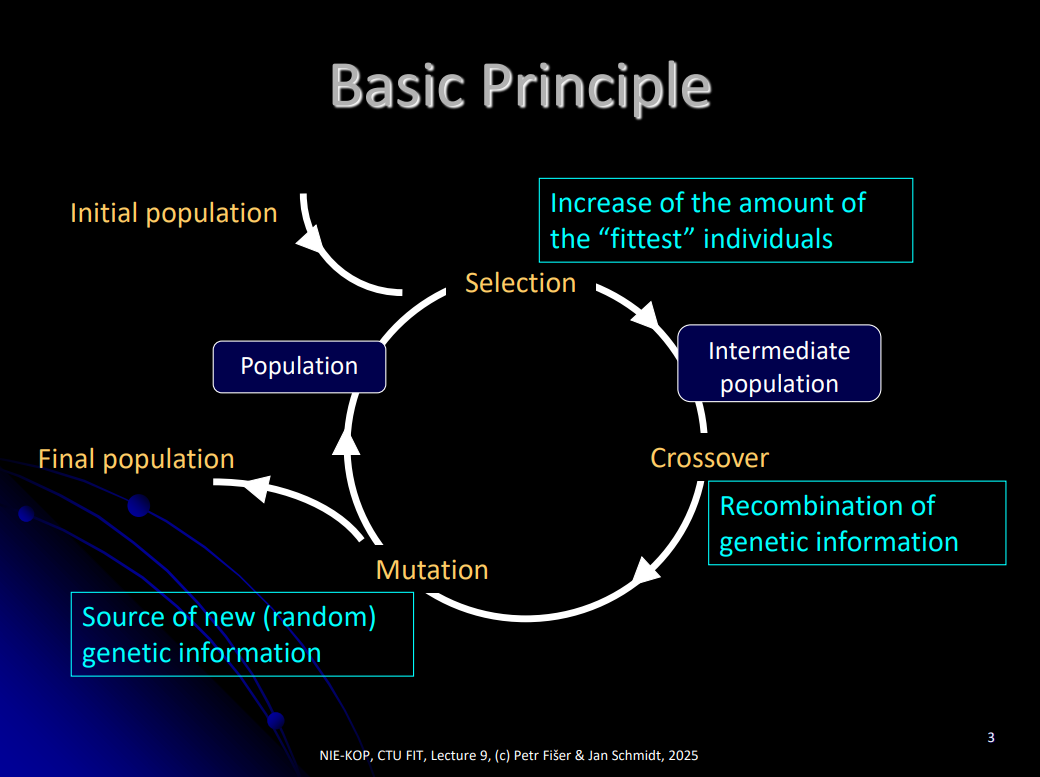
First part: choose the initial population
- first part is constructive (to create the initial population)
- could be constructed randomly or using some constructive method (but random construction is heavily preferred)
- the population size is usually kept the same through the algorithm run
Repeat: selection → crossover, mutation → replace old generation
Fitness function
- at the beginning of the loop, the fitness of each individual has to be evaluated (to perform the selection)
- fitness function is essentially the cost function
- it measures how the given individual is good/bad relative to the whole population
- it has to be calculated for each individual in the current generation
- and then again for the next generation and then again
- it has to be fast (if this is not possible, the genetic algorithm is not the good fit for the problem I am trying to solve)
- the fitness function complexity should be the first thing to consider when considering genetics algorithms
- difference between fitness function and cost function
- fitness function measures the cost of an individual (in the current generation) RELATIVE to the average of the current generation
- fitness function is essentially the cost function
Selection function
- the input to selection is the fitness information about each individual in the current generation
- the primary aim of the selection is to balance intensification and diversification
- selection controls this trade-off
- what is selection pressure?
- it is a probability of selecting the best individual (with fitness )
- every individual has a probability of being selected
- where is the (relative) fitness of -th individual, is the population size
- the formula depends on the selection method (below)
- selection pressure is a property/parameter of the selection strategy that we can control to influence GA behavior
- if the selection pressure is high - results into intensification, converging quickly to the current optimum
- degereration of a population (small diversity, only a small amount of the best individuals are selected and the next generations will likely be copies/combinations of them)
- extreme case: means that only the best individual survives
- if the selection pressure is low - results into diversification, the GA converges to the solution slowly, but it has better exploration
- if the selection pressure is , which is the minimal usable selection pressure, all individuals have the same chance of being selected, the information about fitness is not used and GA basically performs a RandomWalk
- if the selection pressure is high - results into intensification, converging quickly to the current optimum
Selection strategies
- roulette wheel
- the size of an individual’s section on the roulette is proportional to it’s fittness
- individuals with bigger fitness have bigger sections and therefore have the bigger chance of being selected
- the selection is random and the individuals may repeat
- the result is the intermediate population
- a population between selection and crossover/mutation (“between generations”)
- the wheel runs times, so the intermediate population is of the same size as the previous generation
- but more fit individuals could appear more often and the worst individuals could not be selected at all
- the size of an individual’s section on the roulette is proportional to it’s fittness
- roulette wheel - universal stochastic sampling
- the roulette is formed the same way as before
- then a random angle is marked and this angle divides the roulette into equivalently distant sections
- distance is
- the individuals, which are “crossed” with this section are selected
- so again, if the individual has a big section, it has a higher probability of being selected
- DISADVANTAGES OF ROULETTE
- if fitness values of individuals are similar, the roulette has almost no effect (random selection)
- if one individual is significantly more fit than others, it has a great chance of being selected and the worse individuals have almost no chance
- leading to early intensification and ending up in some local optimum
- SOLUTIONS
- linear scaling
- the fitness values are linearly scaled to some defined range
- e.g. rescaling between minimum and maximum values of the fitness functions
- too fit individuals are not that preferred
- too weak individuals have higher chance
- the fitness values are linearly scaled to some defined range
- ranking
- all individuals are ranked by their fitness
- the relative differences and absolute values are lost, only the order (the rank) of individuals is respected
- linear scaling
- tournament selection
- we randomly select individuals and they will “compete” against each other and the winner “continues” to the next generation
- this tournament will be held -times to create a new intermediate generation of the same size
- we can adjust the selection pressure with the variable
- with , the selection is random (there is no selection)
- one individual will be randomly selected and it will always win
- if the is equal to the size of the current generation (), only the best one is continuing into the next generation with no chance for others
- with , the selection is random (there is no selection)
- we randomly select individuals and they will “compete” against each other and the winner “continues” to the next generation
- probabilistic tournament
- the same mechanics as the normal tournament, but the choosing system is different (based on probabilities):
- there is a parameter :
- the best individual is selected with probability
- if not selected, the second best individual is selected with probability
- if not selected, the third one with etc. until an individual is selected
- there is a parameter :
- this allows for better selection pressure control (better than just changing parameter)
- the same mechanics as the normal tournament, but the choosing system is different (based on probabilities):
- truncation selection
- we specify a threshold
- select the fittest individuals
- copy each selected individual times into the intermediate population
- each selected individual will have same amount of copies in the next generation (regardless of the real fitness value)
- common values of : ( and )
- very high pressure, deterministic approach
- fitness information can be encoded compactly (no real values are needed - all individuals within one category are treated equally):
- 1-bit fitness:
- 1 - individual is fit, will advance to next generation
- 0 - individual is not fit, will no advance to next generation (does not have chance)
- 2-bit fitness:
- 11
- 10
- 01
- 00
- can have different rules for advancing to next generation (e.g. 11 will get 2 copies, 10 will get 1 copy, rest will not advance)
- 1-bit fitness:
- we specify a threshold
Crossover function
- many different types and approaches, sometimes it is difficult to find the right one for the specific combinatorial problem
- basic idea:
- usually the properties of two parents are somehow combined to usually produce one or two children (so the children “inherit” parent’s properties)
- it is a binary operation (two parents are needed)
- types:
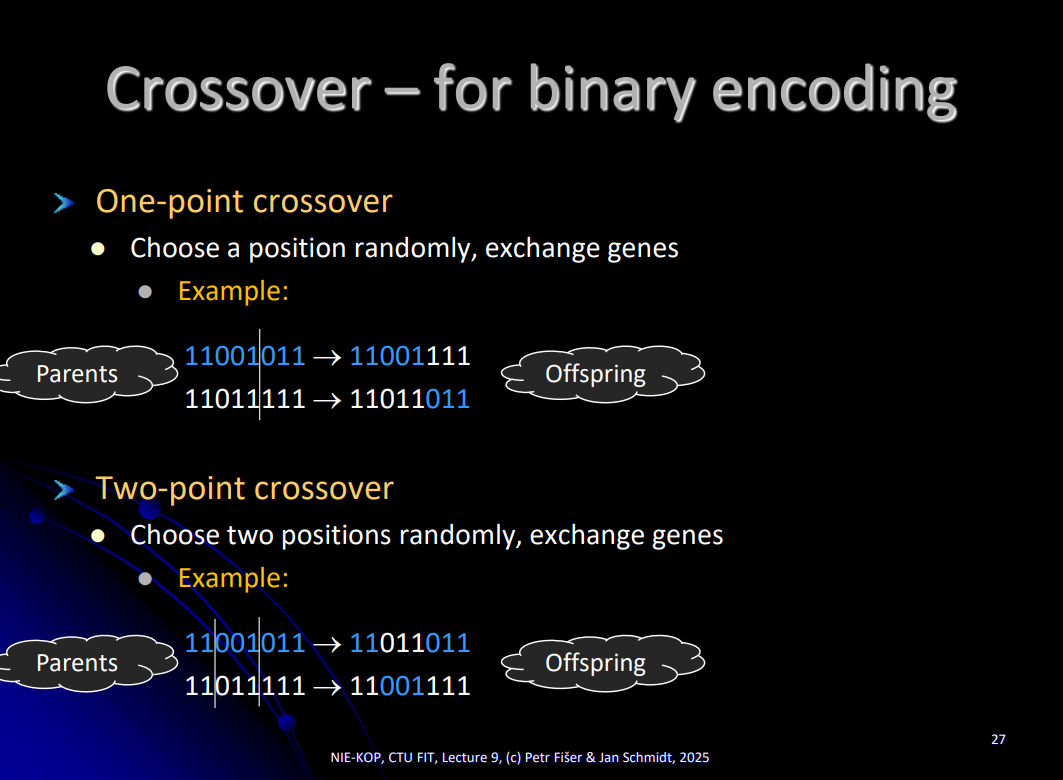
- one-point crossover (for binary encoding)
- the first child gets first part from the first parent and second part from the second parent (the parts are whole and continuous)
- the second child gets a second part from the first parent and first part from the second parent
- the choice of the “line” separating parts in both parents is given randomly
- two-point crossover (for binary encoding)
- two positions for a “line” are chosen randomly and the children get a combination of different continuous parts from parents
- uniform crossover (for binary encoding)
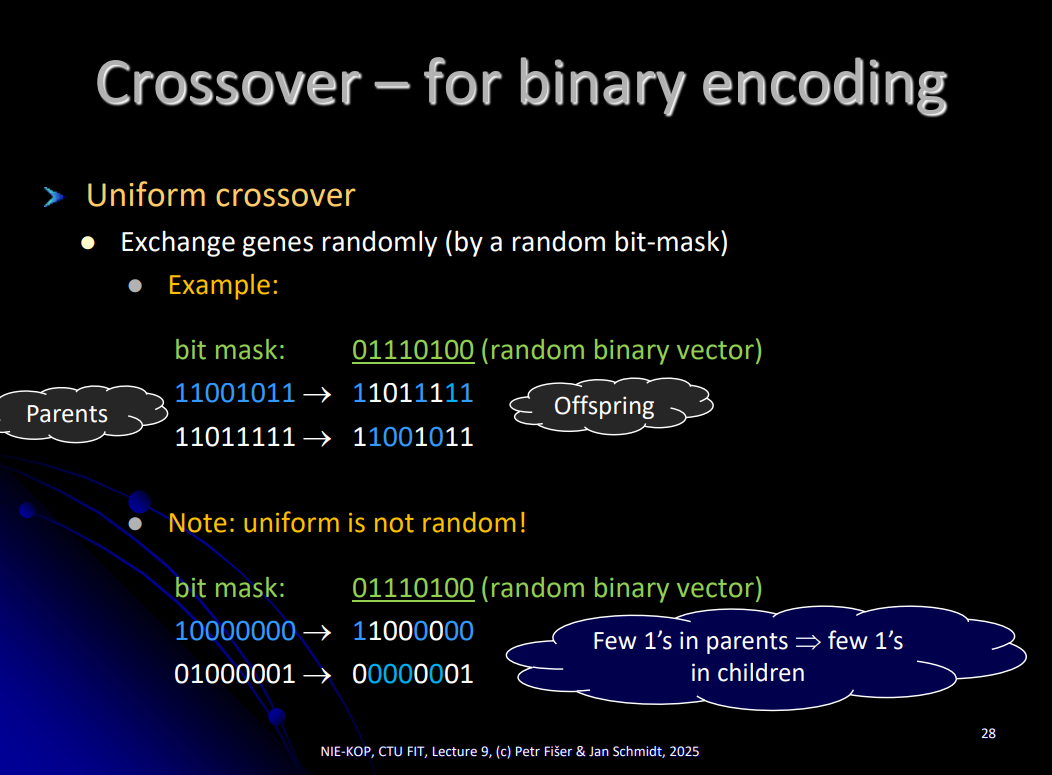
- using a bitmask to decide, which parts of the first parent and which parts of the second parent go to which child
- the bitmask is a random binary vector
- this crossover is not random at all
- I cannot introduce new genes (if both parents have 0’s at some position, so they don’t have the “gene”, this crossover operation cannot create it in the child)
- if both parents have few 1’s, the offsprings will also have a few 1’s
- the bit-mask is random, yes, but the child’s output is not random, it still inherits the properties from the parents
- using a bitmask to decide, which parts of the first parent and which parts of the second parent go to which child
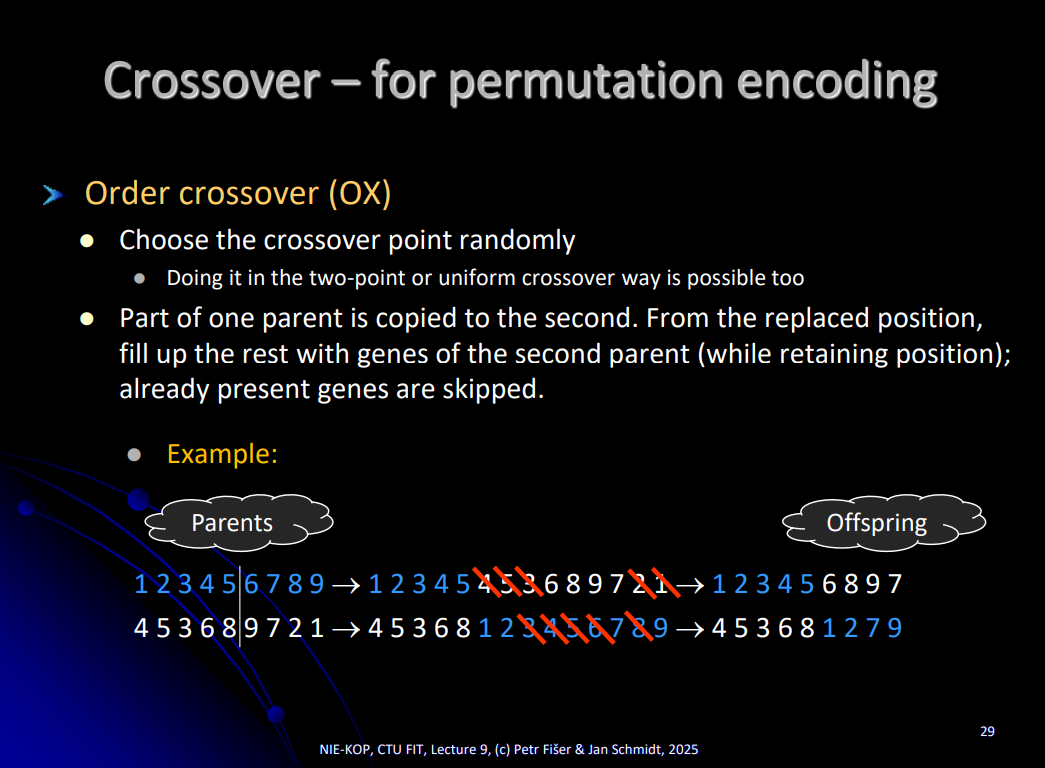
- OX - order crossover (for permutation encoding)
- the line separating the parts is chosen randomly (could be also two-point way or uniform way)
- first child gets first part of the parent (as a copy) and the second part is filled up from the second parent using genes, which are not present yet (from the first parent)
- the filling from the second parent preserves the second parent’s order
- first child gets first part of the parent (as a copy) and the second part is filled up from the second parent using genes, which are not present yet (from the first parent)
- the already included genes are skipped/excluded
- the line separating the parts is chosen randomly (could be also two-point way or uniform way)
- PMX - partially matched crossover
- 3 ←> 1 is skipped because the 3 is already included in the previous set in the table
- the same with 6 ←> 8
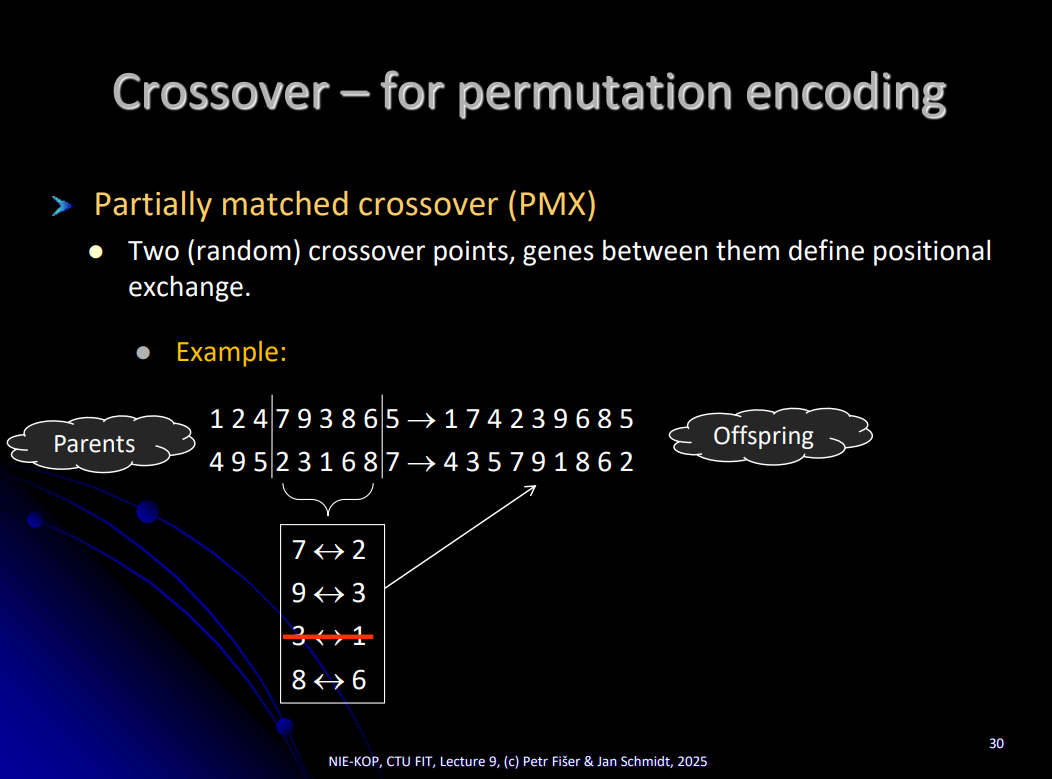
- simply a positional change table is generated from the middle section, which is then applied for both children
- 3 ←> 1 is skipped because the 3 is already included in the previous set in the table
- CX - cycle crossover (for permutation encoding)
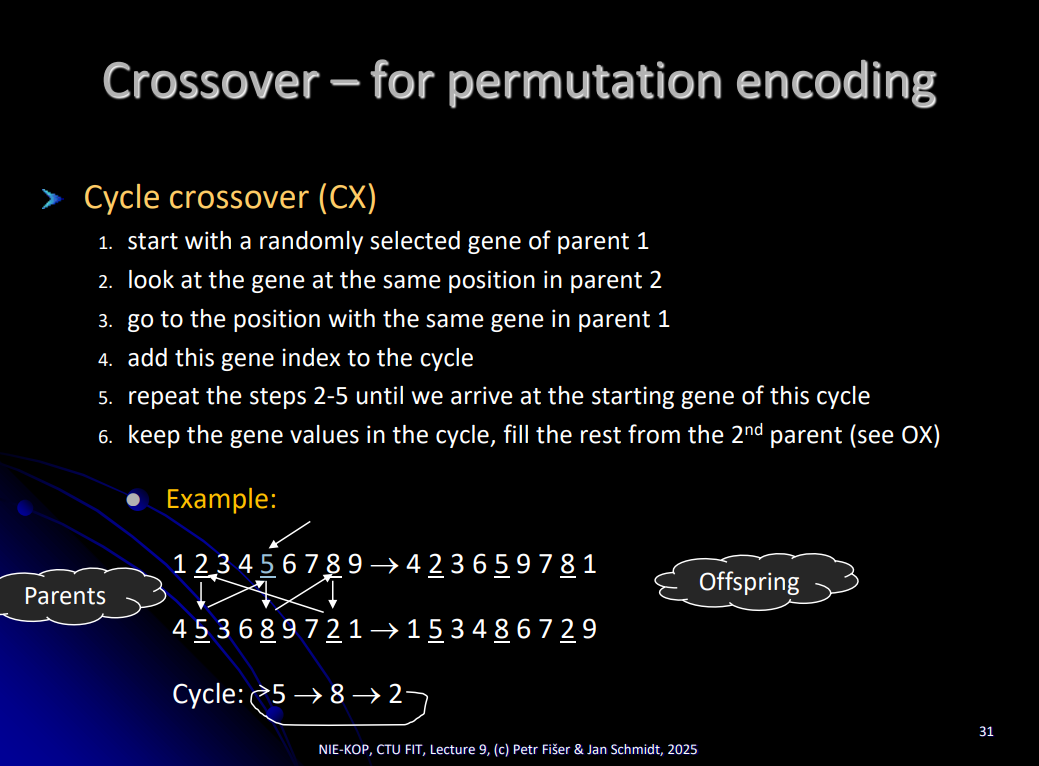
- first phase: build the cycle
- my cycle is now empty
- select the random position (and save it’s value to the cycle)
- selecting 5
- look at the same position in the second parent and see, what value is there - find this value back in the first parent
- looking at 8 in the second parent, finding 8 in the first parent (and saving it into cycle)
- and it repeats: look at the same position as 8 in the second parent, find it in the first parent and save the value in the cycle
- after a finite X repeats, we will arrive back at the first value - this is where the cycle generation ends
- and those values on those positions will “cycle” creating children with different, but inherited properties
- first phase: build the cycle
- one-point crossover (for binary encoding)
Mutation
- mutation randomly changes a gene in an individual
- it’s an unary operator (only a single individual is modified)
- most important property of mutation operation is that the mutation can introduce new genes
- which prevents falling into a local optimum and it also diversifies the population
- but warning!
- more mutations does not mean better solution
- the mutation rate should be small (up to 5%)
- types:
- in binary encoding: random flip of one bit
- in permutation encoding: random exchange of two different positions
- inversion mutation
- special type of mutation, it only reorders values in selected part of the representation (it performs the inversion/reversion of the order)
- it does not introduce new genes, only the positional information is changed
Replacing the old generation
- two ways:
- the whole population is replaced (“en bloc”)
- only part of the population is replaced (from both parents and children, select individuals to the new generation)
- techniques:
- elitism
- we simply copy the best individuals (no selection, crossover and mutation for them)
- the “fast track” to the next generation
- we do not want to accidentally kill them in the process
- too much elitism is also bad (can cause degeneration of the population)
- we simply copy the best individuals (no selection, crossover and mutation for them)
- managing the invalid individuals (infeasible states)
- relaxation (penalize the fitness and they won’t probably be selected in the next round)
- death (kill them and remove them from population)
- decoders
- define crossover and mutation operations in a way, that invalid individuals cannot be made at all
- population size
- is usually constant
- by theory it should grow exponentially with the problem size, but this is often impractical
- but it should scale with the instance size (but not in the exponential way)
- if the population size is too small, there is high risk of diversity loss (degeneration of population)
- elitism
Terminate the loop
- terminate after a fixed number of generations
- or when nothing happens in the last few generations (the changes in the average fitness are small)
- that means the population is not diverse
Usual parameters
- Population size (typically tens–thousands)
- Crossover rate (typically 80–95 %)
- this is probability that a randomly selected parents will undergo a crossover to create children
- if not, the children are exact copies of parents
- it’s a primary exploration mechanism in GA
- Mutation rate (typically 0.1–5 %)
- high mutation rate can destroy good individuals, GA also becomes random search
- low mutation rates do not create enough diversity
- Encoding
- Selection type
- Crossover and mutation type
- Elitism (typically 1-3 individuals)
- Termination condition
Behavior examples in the slides
- slide 61, at the end of the figure, the bad individuals are there because of the mutation
- slide 62, this is essentially a random walk (with remembering the best solutions ⇒ elitism)
- I can see it on slide 63
- slide 64, we didn’t get to the global optimum
Other evolution-based techniques
Genetic algorithms
- are solving optimization combinatorial problems (in discrete solution spaces)
- encoding: strings (binary strings, strings of integers (permutations))
- using crossover operators, replacing generations etc. - like in this lecture
- usage:
- when I have discrete choices and I need to explore many combinations efficiently
- TSP, Knapsack, network design, vehicle routing, timetabling etc.
Genetic programming
- in the 80s there was an idea “how to replace programmers with some evolutionary program”
- the birth of evolutionary programming
- the programs, logic circuits, math equations and structures would evolve and get better and better
- the birth of evolutionary programming
- encoded in trees
- internal nodes = operators, functions
- leaves = variables, constants, terminals
- Genetic programming
- usage:
- symbolic regression (finding mathematical formulas from data) - an alternative to neural networks
- trading algorithms, game AI (behavior trees for in-game characters), circuit design, data mining etc.
- when I don’t know the structure of the solution, just how to evaluate it
Evolutionary programming
- based on evolving and optimizing automatas (e.g. FSM = finite state machine) and their behavior (and state-based systems)
- automatas are fixed in structure, but their parameters are evolving
- encoded as automatas
- operators are only mutations
- changes of output symbols, transitions, initial states
- addition/removal of a state
- crossover would break the automaton’s functionality, mutation preserves the structural integrity
- usage:
- game AI (NPC behavior), robot control (evolving reactive control systems), pattern recognition etc.
Evolution strategy
- evolving physical objects and find maximums/minimums
- they have continuous state space (not discrete)
- encoding in the form of vectors of real numbers and their deviations
- done through recombination and mutation
- these strategies have variable parameter values
- those values can evolve and adapt as well (e.g. the mutation rate)
- “the evolution learns how to evolve better”
- usage:
- engineering (shape of the plane wings, car shapes, turbine blade shapes)
- neural network training, robotics, turing machine optimizations
- antenna design
Tutorial notes
-
the cooling coefficient is related to the inner cycle
- linear change in cooling coefficient there has to be exponential change in the inner cycle count
-
the inner cycle count should scale with the instance size
- for bigger instances there should be bigger inner cycle count
- and I have to scale the cooling coefficient as well
- for bigger instances there should be bigger inner cycle count
-
bad iterative power = the span of the results is big (each run ends in different value and those values are far from each other)
- it does not converge well
Genetics
- if I set the mutation too high or too low, the results are getting worse
- this is good behavior (it’s implemented well)
- the selection pressure is the most important parameter to tune