not “studying” or “describing” it (science does that)
engineers try to make things that do not exist in nature (they have to invent them)
to do that, they have to study math, physics, biology, mechanics etc. (so they have to study science to have all the information)
thus the engineering sciences term comes into play
Forward computations vs. inverse computations
inverse computations are often not possible
I cannot take value X of lift force and then create a proportionally ideal plane wing for it
this is the standard science way (there is a two-way relationship between formulas/properties)
often only forward computations are possible
inventing something → experiment → get data → use (heuristic) knowledge to improve it → experiment → etc.
it is an iterative process forward
involving simulations, experiments etc.
inducing heuristic domain knowledge
Engineering sciences add to the physical sciences
the Laws of Physics are not enough
as the engineers do the deductive forward computations iteratively, they will gain heuristic knowledge (new relationships, properties, additional knowledge etc.)
and the engineers then design the artifacts based on laws of physics + the heuristic knowledge
this is the way to invent
by creating and testing planes, we understand them more, then we create better planes etc.
examples: microelectronics from quantum mechanics
rocket engineering from fluid dynamics
construction from materials science
Conflict with the scientific method and scientific research definition
by Karl Popper, everything has to be falsifiable, but if we are trying to invent something new, it does not exist yet, so it cannot be tested, validated, contradicted…
so the design and engineering of new artifacts is outside of the scope of scientific research, so it cannot be funded the same ways as proper science research
this is why the Science of Design or Design Science exists
we need to support this direction
because this direction (of design science) did not have big support in the past (lack of academic respect, little funding etc.)
normal science was more preferred
design method is different from the scientific method (from the first lecture)
Design Science / The Science of Design
definition from R. Buckminster Fuller (my words):
The function of design science is to solve problems by introducing new artifacts, which will be used by humans and as a result - humans will abandon their previous problem-producing behaviors and devices (artifacts)
The humankind is evolving through the design science
it represents “learning by doing”
it is about constructing, creating, improving
it has more intuitive, inductive (not deductive) and often heuristic character
normal sciences are more deductive
knowledge and insights arise during construction and use
so by constructing, I gain experience and knowledge, construct a better artifact, then gain more experience and with this loop (inductive approach/iterations) I get better and better results
Distinguishing Scientific methods
in general:
formal science
explanatory science
design science (construction and improvement)
in information systems:
behavioral science
design science
Difference between Design and Design Science
it’s about innovativeness:
designing an engine vs. designing a completely new type of engine
it’s also genericity:
designing an engine vs. designing a technique to create new types of engines
Design science in Information Systems
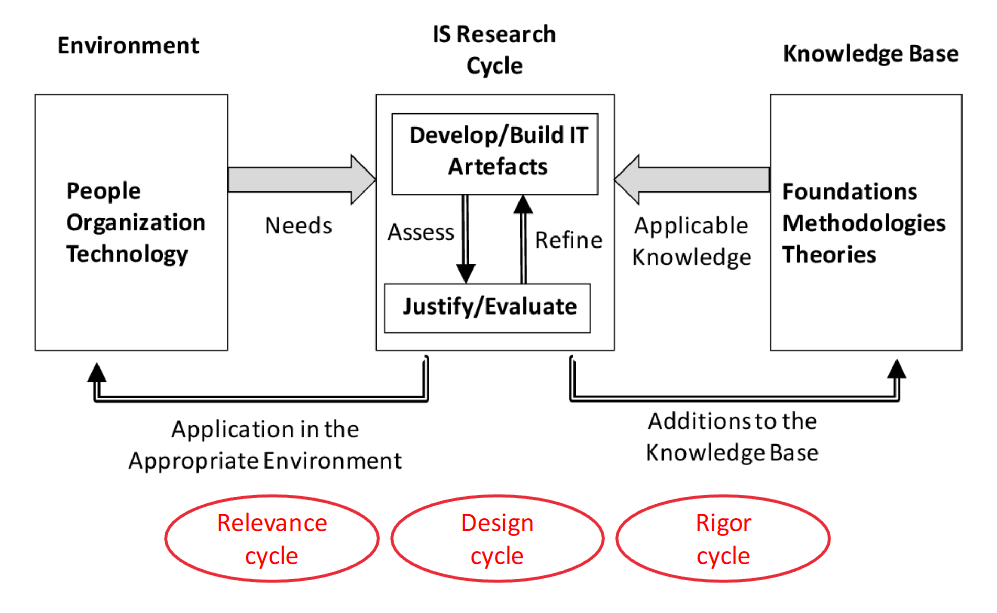
there are 3 cycles
relevance cycle - links research to real-world problems
rigor cycle - grounds the research in knowledge (data, graphs, theories, methods…) and adds new findings back into the knowledge base
design cycle - building and evaluating artifacts
this is the approach to build science-based solutions for information systems