-
modularity is one of the most important concepts in engineering
-
why?
- hierarchical structure allows for better control and separated development
- complexity reduction
- reuse of components
- evolvability/flexibility
-
why is it bad?
- the implementation of a modular structure is not straighforward
- changes, extensions to modules or their non-identical replacement can ripple/propagate through the whole artefact and make serious impacts
- in general:
- deep issues of evolvability and scalability and they increase with the number of variants and modules
-
a modularity is not just something, that lives in the design, the manufacturing process has to adapt for it etc.
-
software program is also an artefact, it constist of the source code artefact and execution code artefact
- it also contains the number of hierarchically structured modules
-
variation gain
- module variants (for building a chair) grow additive
- product/artefact variants grow multiplicative (can be much larger number)
- if grows much faster than the number of module variants
- so the variation gain can be exponential
- the manufacturing process has to be modified as well (be modular and hierarchical as well)
- and there should also be integration units for aggregation (putting modules together)
-
GRASP - Vysoká soudržnost - a design principle: High cohesion
- separating functions into high-cohesive modules (units of work)
- to avoid duplication (by separating the functionality to a single place)
- then changes won’t be done at many place, but just one place
- to be able to easily create more variants and enable support for them
- modules are single units of work that have it’s “interface”, are high-cohesive (all functionality is grouped together)
- modules can have variants, we don’t have to copy the whole artefact if we add another variant
- we get exponential variation gains (which is great, for a relatively small amount of modules and variants, we have a lot of potential artefact variants)
-
GRASP - Nízká provázanost - a design principle: Low coupling
- avoid the propagation of changes to the entire artefact
- danger of exponential ripple costs
- avoid the impact to the integration at deploy
- it is not about not connecting/coupling at all, but carefully thinking about the nature of the connection (if the ripple effects pass through or not)
- so only meaningful connections
- avoid the propagation of changes to the entire artefact
Beware of unleashing the exponential variation gains (though high cohesion), I have to master the coupling as well, so I don’t also get the exponential ripple costs.
Cross cutting concerns
- another dimensions that cut through the whole main hierachical structure
- the can impact and create ripple effects across the main structure
- they should be in their own dimension and be interconnected to the main hierarchical structure
- how to integrate them? There are more levels
- 1A - embedded dedicated integration
- the concern must be embedded and dedicated to each module - it’s special for each structure
- e.g. a special fireplace for every room in a house
- the concern must be embedded and dedicated to each module - it’s special for each structure
- 1B - embedded standardized integration
- the concern is embedded in each module - but it’s standardized, it could be the same for different structures
- e.g. a standardized heaters in every room in a house
- the same thing could be cloned to other houses
- e.g. a standardized heaters in every room in a house
- the concern is embedded in each module - but it’s standardized, it could be the same for different structures
- 2A - relay to dedicated framework
- there is one single dedicated module for the functionality and all modules are relaying it’s functionality to it
- e.g. a special centralized heating system/diesel aggregator/boiler - there does not have to be a fireplace in each room
- there is one single dedicated module for the functionality and all modules are relaying it’s functionality to it
- 2B - relay to standardized framework
- the same, but it’s standardized framwork for more structures
- e.g. the energy system (powerplants, transmission, distribution, consuption)
- there is one system for all structures (houses)
- we don’t have to duplicate
- we have a centralized and standardized framework (the internet connection) and it allows playing Spotify, Netflix, Amazon etc.
- there is no need to establish a new network for it to work
- we have a centralized and standardized framework (the internet connection) and it allows playing Spotify, Netflix, Amazon etc.
- 2C - relay to framework gateway
- there exists a gateway, which provides a dedicated connections for all structures (e.g. houses) and the communicates directly with the standarized framework (and relaying energy, requests etc.)
- thanks to the gateway, it’s easy for all houses to switch the energy provider (it’s not connected directly)
- 1A - embedded dedicated integration
- how do we inteconnect the concerns to the main structure?
- guideline 1: encapsulation
- shield the main hierarchical structure from ripple effects caused by the changes in the concern implementation
- 1A is not encapsulated, 1B is encapsulated (that’s what we want)
- guideline 2: interconnection
- removing duplications (one changes doesn’t have to be made on several places)
- goes with the central implementations and interconnecting to them
- the relays have to be encapsulated as well, so the change of the concern does not have ripple effects to the main structure
- e.g. we can exchange the central heating system without changing the pipes and radiators
- guideline 3: downpropagation
- the changes in the main hierarchical structure may have impacts on the cross-cutting concerns
- e.g. adding one more room also has impact on the central heating system
- how limit the impacts?
- having separate domains for each cross-cutting concern and handle it on fine-grain level
- each module has different layer through which it connects and communicates with other dimensions and concerns
- the changes in the main hierarchical structure may have impacts on the cross-cutting concerns
- guideline 1: encapsulation
Representation framework = Integration Design Matrix
- this matrix representation facilitates the design a hierarchical architecture with multiple concerns
- rows = what levels provide the utility
- columns = what levels consume the utility
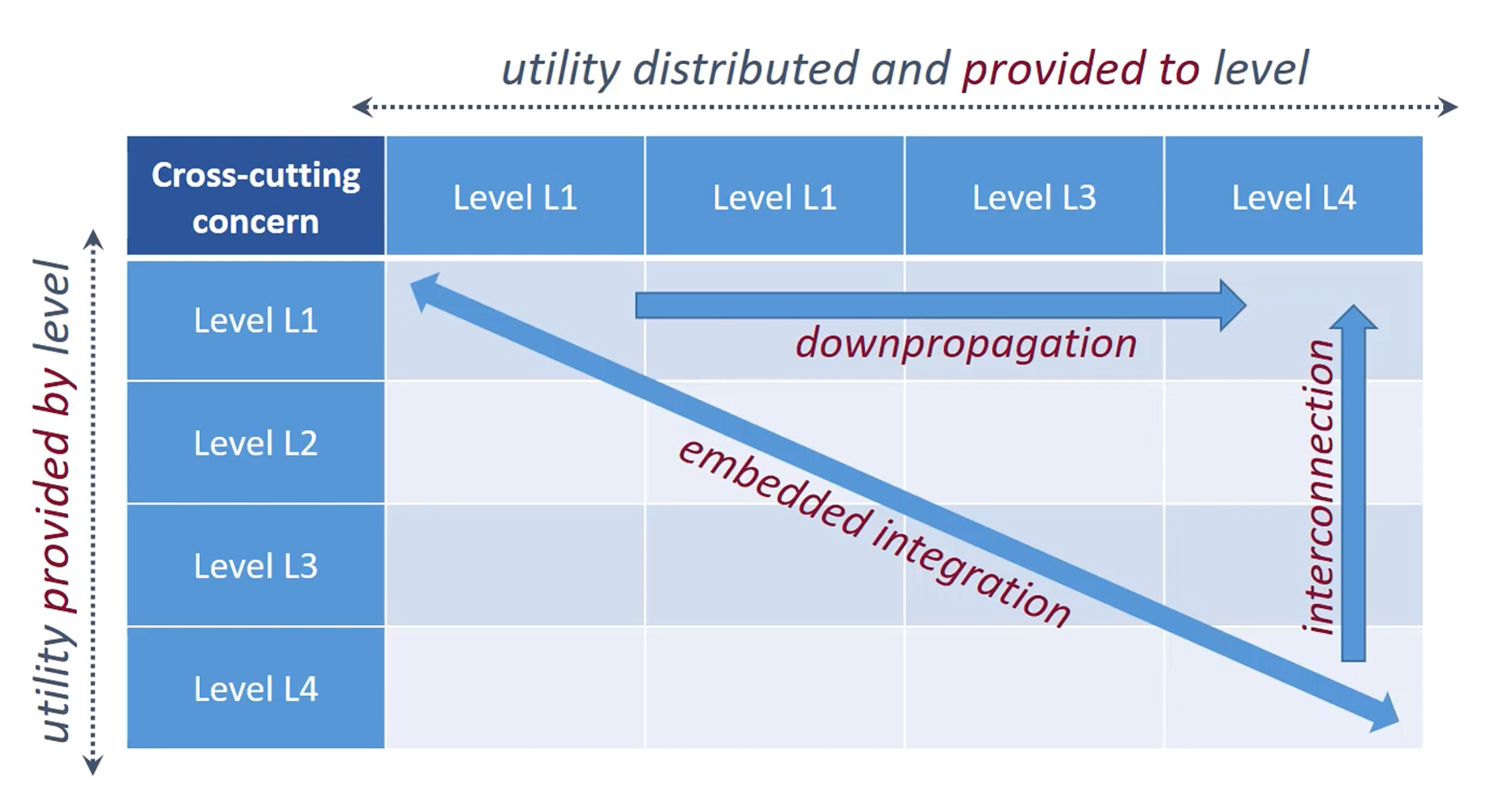
- in the lower left corner, we have “production”
- distributed production, collecting and providing resources for the higher levels
- encapsulation is discussed on the level of each cell
- is it encapsulated, so the external changes won’t affect it?
- in the lower left corner, we have “production”
- level slices
- above the matrix, we have multiple levels of cross-cutting concerns
- we can slice through all planes and see, what is provided at a certain level?