The researcher’s philosophy is the most outer “layer” of the research → every researcher already has a certain philosophy and it directly influences it’s research questions, methods, data collection etc.
- I should be aware of my philosophy and be able to tell why, because it justifies every downstream choice I make in the research
- the final point of the presentation was: Same topic + different paradigm (different philosophy) = different research question/different methods/different contributions
Research paradigms
A research paradigm is “the set of common beliefs and agreements shared between scientists about how problems should be understood and addressed” Kuhn, 1962
- each research is positioned in some kind of paradigm
- see Do you realise that you are in a paradigm?
- the question is, do we realise that we are in some paradigm? Is it a self-fulfilling paradigm?
- do you know that your values and your beliefs can influence the research?
- a research paradigm is built on these pillars (going from up to bottom):
- ontology - how is reality defined?
- epistemology - how do I know something? How do I know what is reality? And what is knowledge?
- theoretical perspective - what approach can we use to get some knowledge?
- methodology - what procedure can we use to get knowledge?
- methods - what tools to use the get knowledge?
- sources - what data can we collect?
Research onion
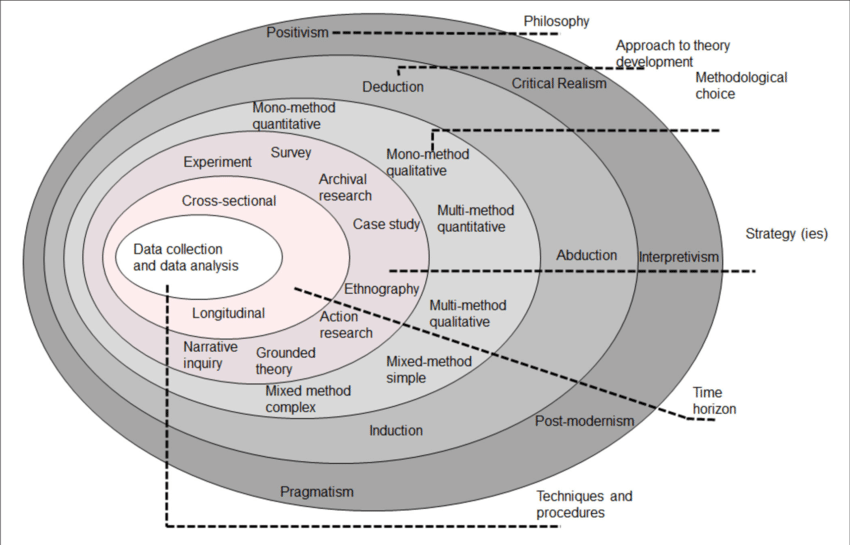
- how the layers nest into each other and what influences what
- we can see that the data collection and analysis are at the center and are influenced by researcher’s philosophy, strategy, methodologies used, time horizon, techniques etc.
Types of philosophical identities
- AI-generated summary of the identities:
1. Positivism - “The Natural Scientist”
Reality is objective, fixed, and measurable. Knowledge comes from observable facts, cause-and-effect relationships, and laws. The researcher is detached and value-free. Methods are quantitative: large samples, structured measurement, experiments, surveys. The criticism is that it strips away social context - a “social vacuum” view.
- deductive approach, quantitative data type
- typical: experiments, surveys
2. Interpretivism - “The Artist/Actor”
Reality is complex, socially constructed through culture and language. Knowledge comes from narratives, stories, perceptions. The researcher is part of what’s being researched - subjectivity and empathy matter. Methods are qualitative: small samples, in-depth investigations, case studies, ethnography, grounded theory. The criticism is accuracy - can you really capture someone else’s lived experience?
- inductive approach, qualitative data type
- typical: case study, grounded theory
3. Critical Realism - “The Archaeologist”
This bridges positivism and interpretivism. Reality is objective but structured and layered - what we see on the surface is caused by deeper hidden mechanisms. Knowledge comes from excavating those mechanisms through historically situated facts and causal explanation. It’s value-laden (recognizes bias but tries to minimize it). Methods are flexible: both qualitative and quantitative, in-depth historical analysis. The criticism is lack of step-by-step methodological guidance - “generative mechanisms” are hard to operationalize.
- abductive or deductive+inductive, qualitative or quantitative data type
- typical: archival research, survey
4. Postmodernism - “The Political Activist”
Reality is subjective, fragmented, and discursively constructed. This paradigm challenges existing power structures and highlights marginalized views. It’s useful for critiquing buzzwords and rhetoric (e.g., deconstructing what “agility” really means in corporate governance speak). The criticism is that it offers limited practical solutions.
- abductive or deductive+inductive, mainly qualitative data type
5. Pragmatism - “The Architect”
Reality is the practical consequences of ideas. Knowledge comes from solving problems in specific contexts - whatever works. The researcher is reflexive and value-driven. Methods are mixed: whatever fits the research problem, often action research. The criticism is that researchers sometimes bundle quantitative and qualitative data without truly integrating them.
- abductive or deductive+inductive, any data type