Definition:
A theory is a system of constructs and relationships between those constructs that collectively present a logical, systematic, and coherent explanation of a phenomenon of interest
Theory description
- Theories used in IS research - wiki
- theories are the core outcome of any research process
- they provide us with guidance in the planning of the research or in execution of the research (e.g. framework to structure empirical observations and sensemaking)
- what is not a theory?
- it is not universal (it has assumptions and boundary conditions) and not self-perpetuating (it is not an end to itself, it has implications)
- it is not:
- pure data
- description
- prediction
- design
- list of hypotheses (they need to be grounded and justified)
- theory is not ideografic (= explanation of a single situation)
Key building block of a theory
- Constructs (“What?”)
- they can have different roles: independent/dependent/mediating and moderating constructs
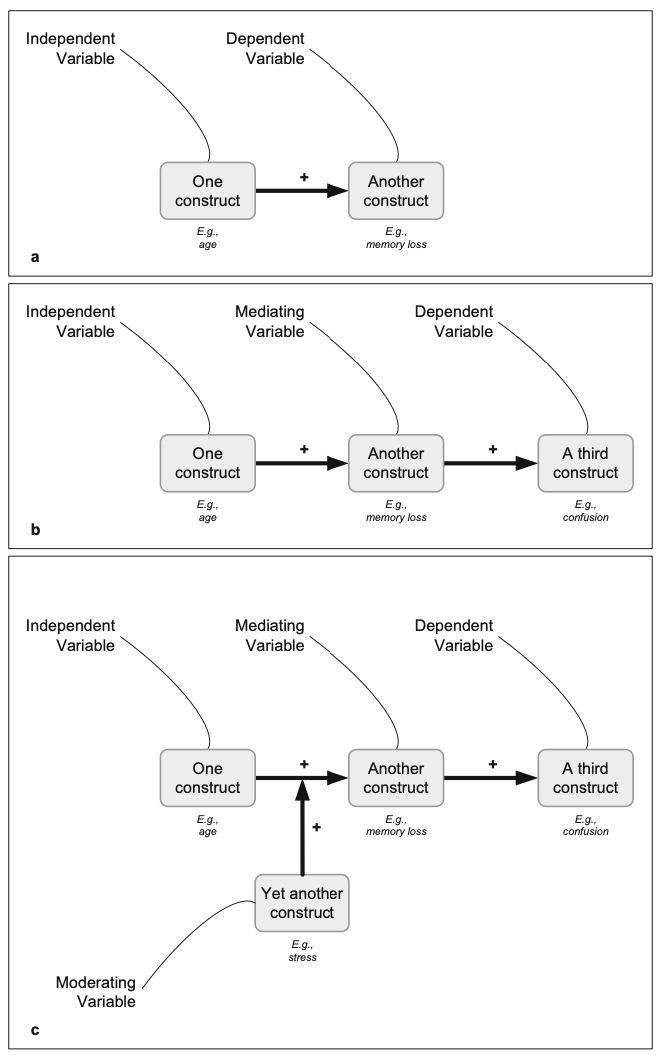
- Relationships between constructs (“How?”)
- may be: associative, compositional, unidirectional, bidirectional, conditional or causal
- they often have a direction and they could have strength
- they are testable, which is what distinguishes them from mere associations
- Justifications (“Why?”)
- this could be a theoretical backdrop from a different theory/other fields
- answers “why would this relationship exist?”
- this is also called “theoretical grounding” or “logical argument”
- Boundaries (“Who/Where/When?”)
- for description of the circumstances under which the theory holds
- also defines “scope conditions”
- a theory without stated boundaries in unfalzifiable (see Falsifiability)
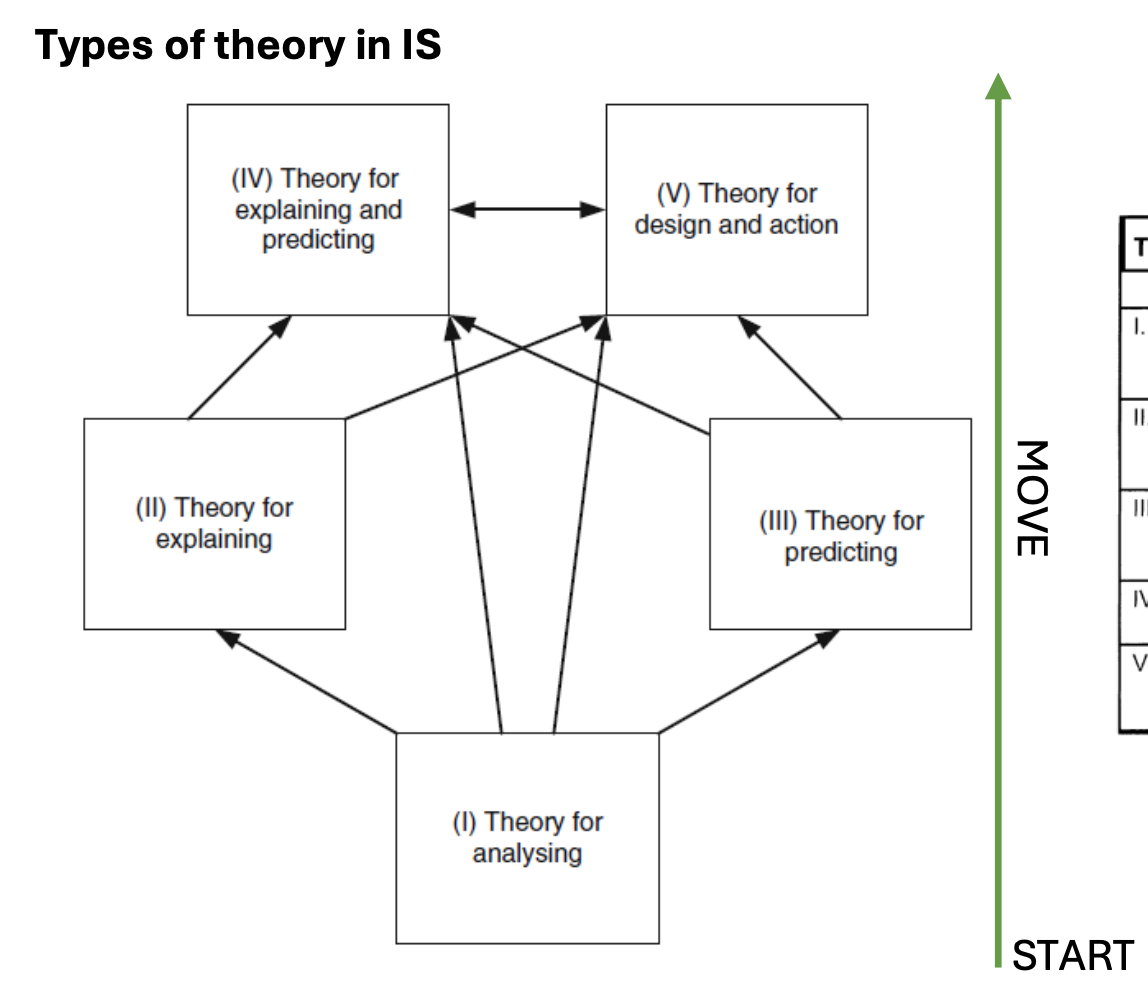
Types of theories in IS
I. Analysis
- Says what is. The theory does not extend beyond analysis and description. No causal relationships among phenomena are specified and no predictions are made.
- For the beginning, descriptive research, here is where most research works start
II. Explanation
- Says what is, how, why, when, and where. The theory provides explanations but does not aim to predict with any precision. There are no testable propositions.
- Building theoretical background (definitions, building blocks …)
- Explaining mechanisms without the predictive power
III. Prediction
- Says what is and what will be. The theory provides predictions and has testable propositions but does not have well-developed justificatory causal explanations.
- Often used in ML/data-based research, they also have weak causal grounding (which is a drawback)
IV. Explanation and prediction (EP)
- Says what is, how, why, when, where, and what will be. Provides predictions and has both testable propositions and causal explanations.
V. Design and action
- Says how to do something. The theory gives explicit prescriptions (e.g., methods, techniques, principles of form and function) for constructing an artifact.
- Aimed for designing an artefact
- Design Science Research
Relationships between theory types
- we usually move from the analysi upwards (according to the diagram)